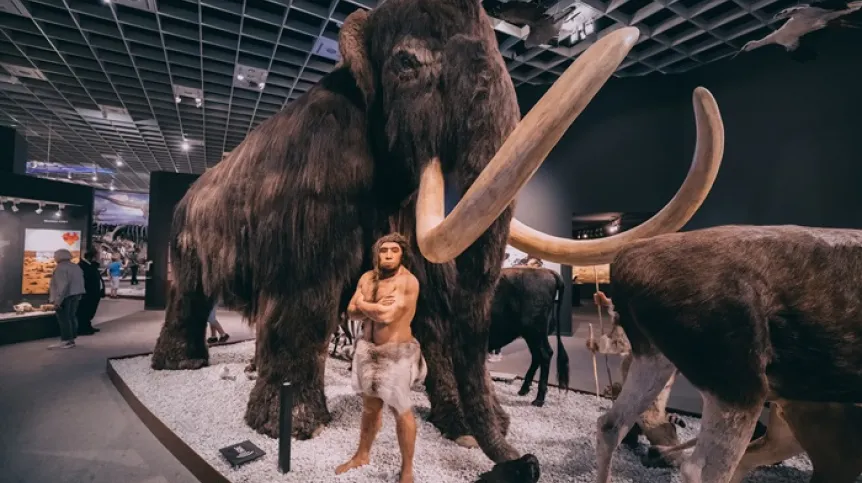
Ice Age hunters may have preferred hunting female woolly mammoths, according to an analysis of ancient DNA from more than 500 mammoth bones.
The study, published in Current Biology, found a striking difference between mammoth remains from natural sites and those from locations associated with human activity.
The international research team included experts from the Institute of Systematics and Evolution of Animals of the Polish Academy of Sciences.
The scientists analysed genomic data from 521 woolly mammoths from Eurasia and North America. DNA from 448 individuals was sequenced for the first time.
The bones came from 11 key archaeological sites in Eurasia, including Kraków Spadzista, and date to approximately 30,000–20,000 years ago.
Genetic analysis allowed the researchers to determine the sex of the animals and revealed significant differences depending on where the remains were found.
At scattered natural sites, males accounted for 66% of the remains and females 34%.
The researchers said this was consistent with the hypothesis that solitary males were more likely to die in natural traps such as sinkholes or landslides, increasing the chances that their bones would survive for thousands of years.
At archaeological sites associated with human activity, the pattern was reversed.
Females accounted for 70% of the remains, compared with just 30% for males.
The finding led the researchers to consider how Ice Age hunter-gatherers obtained and used mammoths.
'We know that Upper Palaeolithic hunter-gatherers sometimes hunted mammoths directly, as evidenced by projectile points embedded in their bones. They could also obtain meat and other raw materials from dead animals', said Jarosław Wilczyński, PhD, an archaeologist involved in the research at the Institute of Systematics and Evolution of Animals of the Polish Academy of Sciences, quoted in the press release.
The researchers said it would be tempting to assume that hunters chose females because they were smaller than adult males, but the explanation could be more complex.
If mammoths behaved similarly to modern elephants, females would have lived in matriarchal herds and could have defended themselves collectively. Encounters with such groups could therefore have been as dangerous as encounters with males.
'Another possibility is that female-led herds moved across the landscape in more predictable ways than solitary males, meaning Upper Palaeolithic hunter-gatherers may simply have encountered them more frequently, whether for hunting or scavenging', explains Hannah M. Moots, PhD, from the Centre for Palaeogenetics in Stockholm, lead author of the study.
The scientists compared data from 100 mammoths found at sites associated with human activity with information on 421 individuals from natural accumulations of remains.
The researchers said the large dataset provides a broader picture of the relationship between humans and woolly mammoths during the late Pleistocene.
Mammoths were an extremely valuable resource for Ice Age people. They provided meat, fat and hides, while their bones were used to build structures and their tusks to make tools, ornaments and works of art.
'This research demonstrates the power of ancient DNA studies to answer long-standing archaeological questions. By scaling up sample sizes, ancient DNA can go beyond evolutionary history to teach us about animal behaviour and human culture tens of thousands of years ago', adds Love Dalén, Professor in Evolutionary Genomics at Stockholm University. (PAP)
ekr/ zan/
tr. RL