
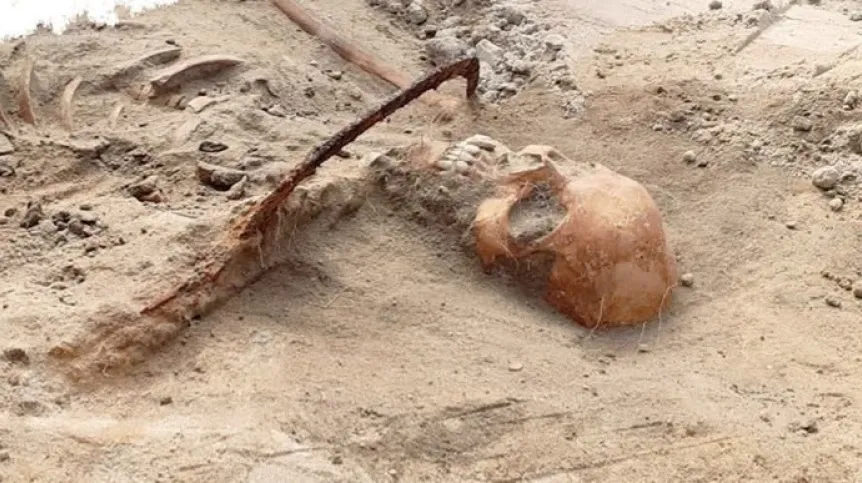
A 17th-century woman buried with a sickle around her neck and a padlock on her toe may have come from outside the local community, while a mysterious copper object placed in her mouth suggests locals took further measures to protect themselves from her after death, new research shows.
The woman, later named “Zosia”, may have been a source of fear both during her lifetime and after her death. Her grave was discovered in 2022 in the village of Pień, in Poland’s Kuyavian-Pomeranian Voivodeship, by archaeologists from Nicolaus Copernicus University in Toruń led by Dariusz Poliński, PhD, a professor at the university.
The burial attracted particular attention because of the unusual measures taken to secure her body: a triangular padlock was attached to the big toe of her left foot, while a sickle was placed around her neck with its blade pointing towards her throat.
In 2024, an interdisciplinary team of anthropologists and doctors reconstructed her face, bringing further attention to the young woman who had been buried more than 350 years ago.
Since the discovery, scientists have conducted radiocarbon dating, DNA analysis, elemental composition studies and stable isotope analyses to learn more about her life and burial. Their findings have been published in the Journal of Archaeological Science: Reports.
The combination of at least two protective objects, previously unseen together in the archaeological literature, indicates that the local population considered the woman dangerous.
They most likely believed she could be responsible for misfortunes such as disease and famine, which frequently affected communities in the Polish-Lithuanian Commonwealth during the 17th century.
The padlock appears to have been placed on her left big toe during the original burial.
‘In funerary symbolism, it primarily signified the end of earthly life and the passage to the world of the dead. It could also symbolically prevent contact between the living and the dead, end a streak of bad luck, or protect the community from the deceased's return. In some interpretations, it was also believed to help stop the spread of epidemics’, Dariusz Poliński explains.
Shortly after the woman’s death and burial, locals appear to have decided that her body needed additional protection.
A sickle was placed around her neck with the blade pointing towards her throat. According to the beliefs surrounding such burials, if the deceased attempted to rise from the grave, the sickle would decapitate or cut her throat and prevent her from returning to the world of the living.
Iron and sharp tools were considered particularly effective protection against demons, witchcraft and evil spirits in folk tradition.
According to the researchers, the grave was probably reopened to add the sickle. The bones remained in their anatomical positions, indicating that this happened relatively soon after burial, before the body had fully decomposed and while soft tissues were still holding the skeleton together.

Analysis of the wooden sickle handle indicates that it was most likely made from birch, alder or maple.
Birch, in particular, was believed in folk culture to have protective properties against demons and witchcraft, which may have added to the symbolic significance of the object.
But the sickle and padlock may not have been the only protections placed on Zosia.
Researchers found extensive greenish discoloration concentrated mainly on the palate, as well as at the base of the skull, inside the nasal cavity and on the first two cervical vertebrae.
Scientists have ruled out the possibility that the discoloration was caused by a coin, as this would have produced significantly less staining.
The findings suggest that a third protective object may have been placed in the woman’s mouth.
‘We have not yet been able to determine what it was. If it was an object, it was made of copper or had a high copper content. This protection was also present at the original burial. The protection at the original burial and subsequent ones added after the grave was reopened clearly indicate a great fear of +Zosia+, Poliński points out.
The analyses indicate that Zosia died around the middle of the 17th century. She was between 17 and 19 years old and stood between 162 and 168cm tall.
Genetic studies suggest that she may have come from Scandinavia, although strontium isotope analysis does not support that hypothesis.
Instead, the isotope results indicate that she was more likely a migrant of at least second degree. Researchers say she grew up in the area of modern-day Pień.
The evidence also suggests that she may have belonged to the upper classes.
Fragments of a decorative woven ribbon found around her jaw had a silk warp, while four threads made from pure silver and gold were placed along the edges of the ribbon.
Researchers found no significant copper content in any of the samples examined, although copper is often found in decorative threads dating from the 17th century.
Previous studies showed that Zosia suffered from a haemangioma, a tumour in the sternum that may have caused pain and contributed to a visible lump on her chest.
The condition was most likely not the cause of her death, however. Scientists are getting closer to determining how she died, but further research is needed to establish the cause definitively.
Several hundred so-called anti-vampire burials are known across Central and Southeastern Europe, dating from the late Middle Ages to the modern era.
In Poland, the largest necropolis with such burials is located in Pień. A team led by Poliński has identified 101 burials there, including at least a dozen considered atypical.
The research involved scientists from Nicolaus Copernicus University, Lodz University of Technology, Gdańsk University of Technology, the University of Warmia and Mazury, Liverpool John Moores University and the University of North Texas Health Science Center.
PAP - Science in Poland, Ewelina Krajczyńska-Wujec
ekr/ zan/
tr. RL