Mice and voles may use the sounds of other animals to work out whether a predator is nearby and even whether a place is safe enough to feed.
Polish scientists found that rodents responded differently when they heard the call of a predatory owl or the song of a nightingale, suggesting that the behaviour of one species can provide another with clues about danger.
The researchers describe this as a possible “landscape of safety”, the opposite of the better-known “landscape of fear” in which animals avoid places they perceive as dangerous, even when food is available.
The study was conducted by scientists from the Mammal Research Institute of the Polish Academy of Sciences in Białowieża, the Faculty of Biology of the University of Warsaw and the University of East Anglia. The results were published in the journal Behavioral Ecology and Sociobiology.
It has long been known that animals can recognize signals indicating the presence of a predator. Places perceived as more dangerous are avoided, even if they offer food – a phenomenon environmental scientists call a “landscape of fear”.
The authors were interested in the opposite question: can animals also recognize signals indicating that an area is relatively safe?
“The concept of the ‘landscape of fear’ explained many previously inexplicable animal behaviours very well. However, we began to wonder that they cannot feed while constantly feeling threatened. So they must have some clues that tell them that the area is safe,” said Professor Andrzej Zalewski from the Mammal Research Institute of the Polish Academy of Sciences.
This led the researchers to investigate whether rodents could recognize a “landscape of safety” from the behaviour of another species.
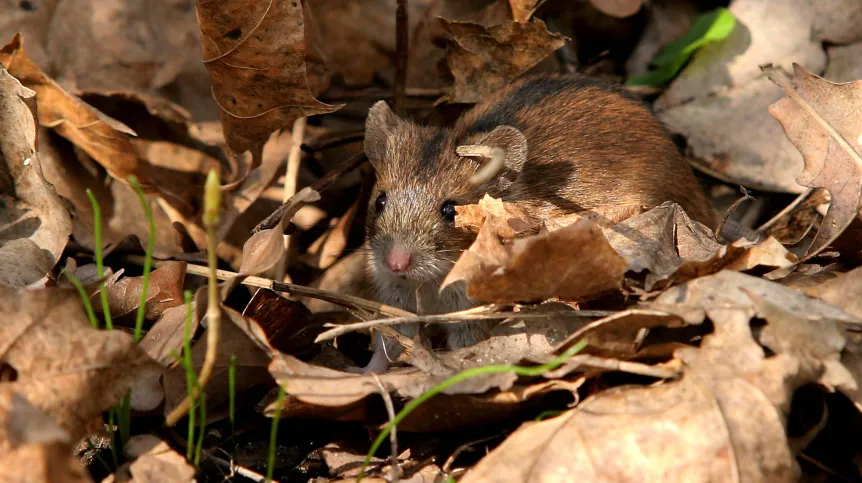
They designed an experiment involving yellow-necked mice and bank voles. Both species are frequent prey of the tawny owl, which hunts at night, flies very silently and can attack unexpectedly, making it difficult for rodents to spot it in time.
“A clue that there is no danger nearby may be the behaviour of another species. If animals share a common predator, the calm behaviour of one of them may be a signal to the other that the place is safe. For a rodent, the song of a nightingale may be such a signal. A bird that sings reveals its presence, so in a threat situation it tends to limit its vocal activity,” Zalewski said.
The research was conducted in the forests of Masuria. The scientists placed 24 feeders containing food for rodents, with a camera trap beside each one to record visiting animals.
For 12 nights, the researchers played three types of stimuli at the feeders, using different combinations at each site. On four nights, the rodents heard the call of a tawny owl. On four other nights, they heard the song of a thrush nightingale, treated as a potential safety signal. The third condition was silence.
The researchers also changed the amount of cover around the feeders. Sometimes they covered them from above with camouflage netting and leaves, reducing the risk of an owl attack. At other times, the feeders were left uncovered.
The camera traps recorded almost 12,800 videos in total. Yellow-necked mice appeared in nearly 9,800, while bank voles appeared in almost 3,000.
Analysis showed that the rodents’ behaviour was influenced by both the sounds played and whether the feeder was covered.
Mice were more likely to appear at feeders when they heard the nightingale’s song than when they heard the tawny owl’s call. However, there was no difference between the response to the nightingale’s song and silence.
The mice also used covered feeders more often than uncovered ones. This was most noticeable when the surroundings were silent. When cover was present, however, playing the nightingale’s song had less effect on the mice. According to Zalewski, this may mean that rodents use several different cues and that their importance changes depending on the circumstances.
“If a mouse has a cover above it, it cannot be attacked by a tawny owl from above, so other signals become less important to it. But if it does not have such protection, it may look for other clues that it is safe. In this case, it pays attention to the nightingale’s singing, indicating the lack of threat,” the researcher said.
Voles reacted slightly differently. They were more likely to visit a feeder if the nightingale’s song had been played there the previous night than if it had been silent. The authors therefore suggest that information indicating relative safety may influence the choice of feeding site on subsequent days.
The study did not provide a clear answer as to why the rodents responded to the nightingale’s song. Zalewski suggested several possible explanations. The nightingale could, for example, distract the tawny owl’s attention from the rodents or, through its loud singing, mask the sounds they make as they move among leaves and grass.
“If someone had asked me two years ago what the relationship between a nightingale and a mouse was, I would have said that there was none. Meanwhile, it turned out that the behaviour of one species can influence the behaviour of another, although at first glance they have nothing in common,” Zalewski said.
There are already many examples of animals responding to alarm calls from other species. If, for example, a nuthatch warns of a predator, tits also react to its call. They can even distinguish from the type of alarm whether the threat is a marten or an approaching hawk or sparrowhawk.
Far less is known, however, about the reverse scenario – animals using another species’ calm behaviour as a signal that there is probably no danger.
“Such interspecies interactions are very rarely detected. But perhaps they are actually common, and we simply have not noticed them yet,” Zalewski said.
PAP - Science in Poland, Katarzyna Czechowicz
kap/ agt/
tr. RL