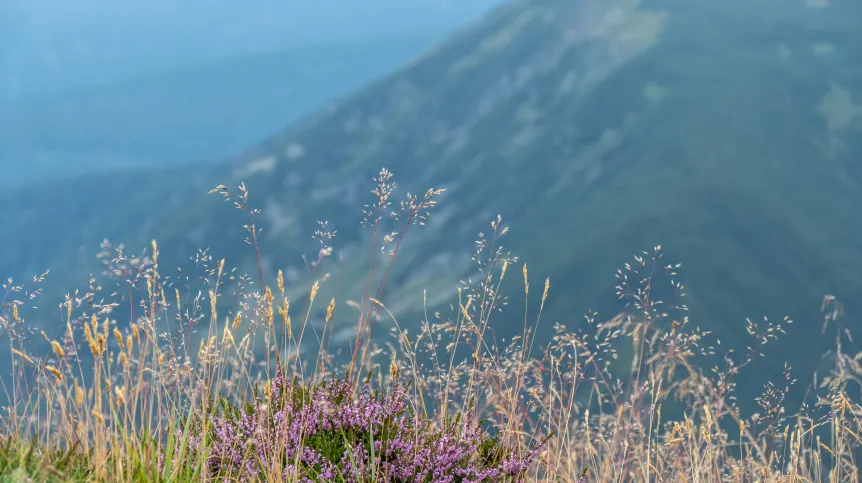
Plants on mountain summits are being reshaped by global warming, with vegetation shifting towards species that favour warmer conditions five times faster than in forests or grasslands.
The change is driven mainly by the decline of cold-adapted plants, rather than the arrival and spread of new species, according to an international study published in Nature. Researchers analysed long-term observations from 6,067 sites across Europe, including mountain, forest and grassland habitats.
Marek Malicki, PhD, from the Botanical Garden of Medicinal Plants at the Department of Biology and Pharmaceutical Biotechnology of Wroclaw Medical University, co-authored the study, the university reports.
The researchers set out to establish how quickly plant communities are changing in response to rising temperatures. To do so, they needed more than a snapshot of current vegetation: they compared observations from the same locations over time, with intervals between surveys ranging from 12 to 78 years.
Some of the data came from Lower Silesia. Malicki provided long-term botanical observations from two areas: the swamp forests of the Barycz Valley and the high-mountain plant communities of the Karkonosze Mountains. He compared these with research carried out at the same sites several decades earlier.
‘My contribution consisted primarily of providing the results of long-term botanical observations conducted in two areas: the swamp forests of the Barycz Valley and the high-mountain plant communities of the Karkonosze Mountains. I compared these with the results of research and observations carried out in the same locations several decades earlier. This allowed to track long-term changes in the composition and structure of the vegetation, and assess the direction of these shifts in the context of climate change’, says Malicki, quoted in the release.
The international team followed the same methodology across the study areas, comparing vegetation in identical or carefully reconstructed plots. They excluded sites where land use had changed fundamentally, such as forests that had been cleared or meadows converted into cropland.
The researchers used the geographical distribution of plant species and the temperatures in their habitats to establish their thermal preferences. They then assessed whether species associated with warmer conditions had become more prominent over time. This process, known as thermophilisation, indicates a shift in plant communities towards species better suited to higher temperatures.
The strongest changes were recorded on mountain summits. There, thermophilisation was driven mainly by a falling proportion of cold-adapted species. In other words, the shift towards warmer-climate vegetation was largely a result of existing plants disappearing, rather than new species moving in.
In meadows, by contrast, the trend was driven more by an increase in heat-loving plants. In forests, both processes contributed. However, the overall changes in these two habitats were considerably weaker, and uncertainty in the results made the findings less conclusive than those for mountain summits.
The team also compared the pace of vegetation change with the rate of warming. In forests and on mountain summits, plant communities were changing more slowly than temperatures were rising. The researchers describe this growing gap as a ‘climatic debt’.
Even in areas where vegetation was responding most strongly, plants were not keeping pace with the changing climate. Malicki says this is partly because plants need time to grow, reproduce and spread to new locations. Perennial species can survive in the same place for decades, even as conditions gradually become less suitable for them.
Forests have an additional buffer: tree canopies limit the amount of heat reaching the forest floor. This can soften the immediate impact of rising temperatures, but it can also delay visible changes in the plants growing below.
As a result, a forest that appears unchanged may still be under pressure from climate change. Malicki says monitoring should therefore look beyond the overall appearance of vegetation and track earlier signs of change, including the balance between warmth-loving and cold-adapted plants, tree regeneration and the microclimate beneath the canopy.
These indicators can reveal shifts that might otherwise go unnoticed until their effects become apparent years later. (PAP)
PAP - Science in Poland
ros/ bar/
tr. RL