
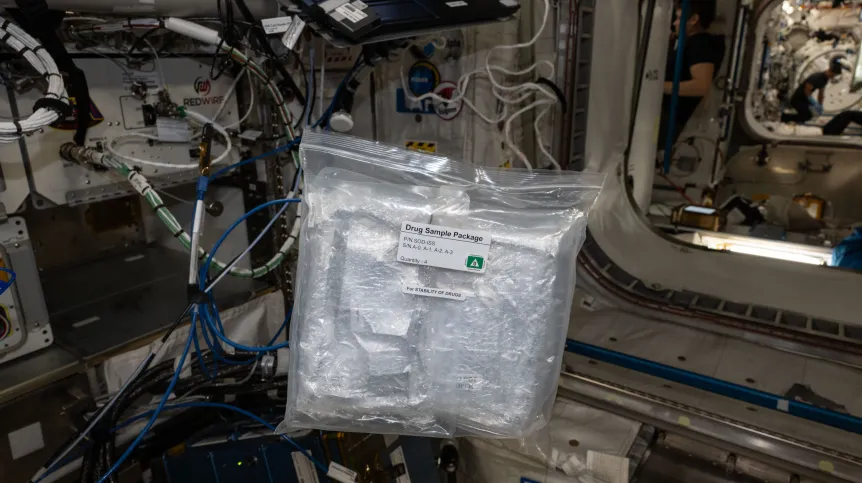
Researchers involved in the IGNIS mission on the International Space Station are continuing an experiment examining how cosmic radiation affects drugs placed in biodegradable polymer carriers.
The research focuses on whether polymer matrices used in drug delivery systems can also protect medications from radiation.
Full results of the “Stability of Drugs” experiment are expected at the turn of 2029.
“However, we are only at the very beginning of the experiment. Last year, after launching samples to the International Space Station, we conducted preliminary characterizations of pharmaceutical substances, polymers, and polymer drug delivery systems. Now we're waiting for the samples to return to us after incubation in orbit,” Jakub Włodarczyk from the Centre of Polymer and Carbon Materials of the Polish Academy of Sciences in Zabrze said.
The first batch of samples is scheduled to return to Earth in the summer of 2026 after spending a year in low Earth orbit. The final set is expected to return in 2028, meaning full experimental results will only be available at the turn of 2029.
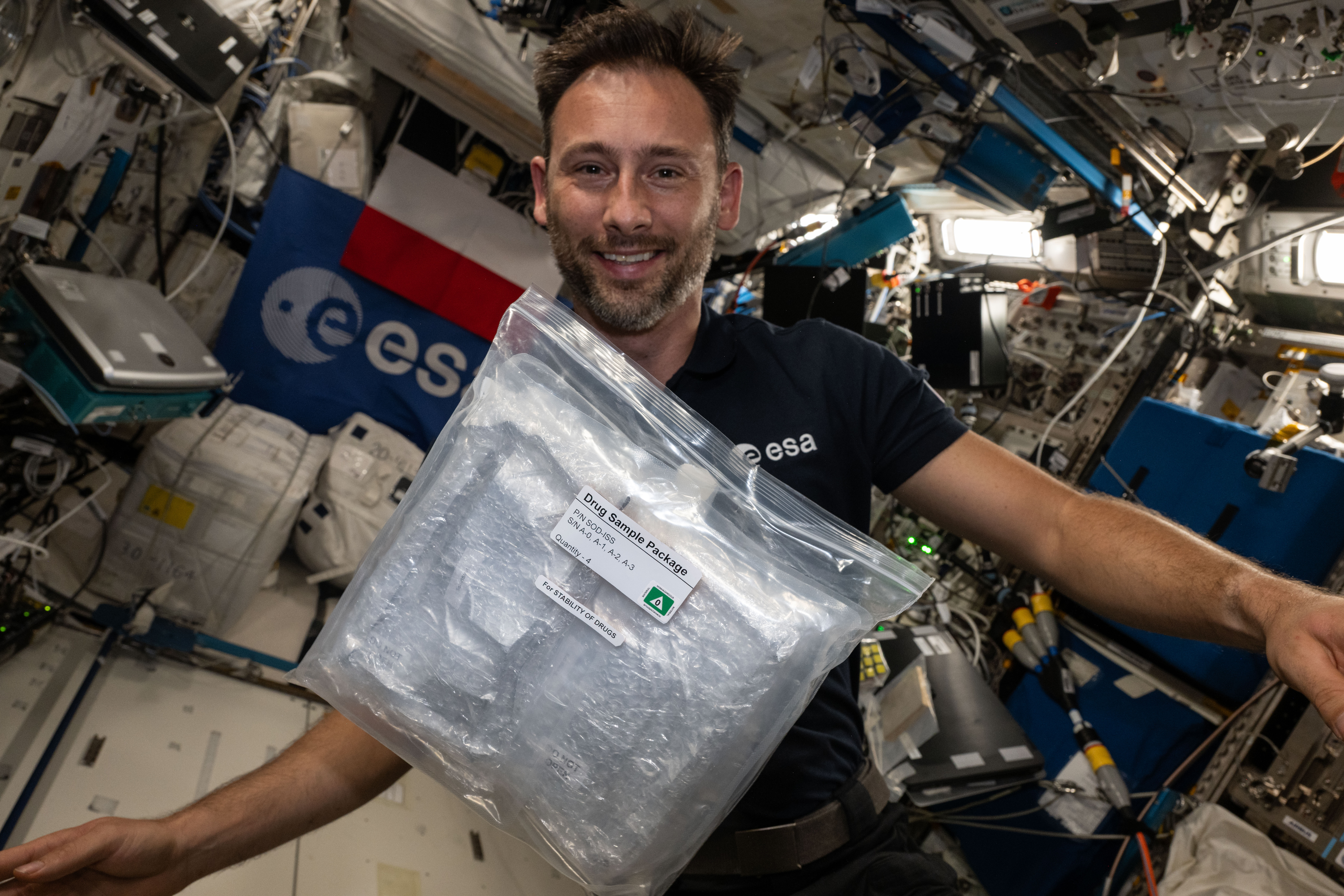
The experiment examines drug delivery systems based on biodegradable polymer matrices that are gradually absorbed by the body. Researchers developed film-based systems in which particles of active pharmaceutical ingredients are embedded within the polymer structure.
Once formed, the systems can be administered in several ways, including subcutaneously, intramuscularly, transdermally or through inhalation. As the polymer carrier degrades in tissues, the drug is gradually released. Depending on the design, the release process can last from several dozen hours to several weeks.
Materials used in the study include polylactide, polylactide-glycolide copolymer and polycaprolactone, a particularly durable polymer that is increasingly used in medical applications. Similar delivery systems are already used on Earth in experimental and conventional treatments, including cancer therapies, chronic pain management and hormonal treatments.
“Not every type of plastic causes problems. The one we use is 100% safe, biocompatible, and the body simply +degrades+ it, leaving no microplastic particles behind,” Włodarczyk said.
Six types of drugs with different physicochemical structures were selected for testing on the ISS: an antibiotic, a radioprotective drug, a steroid, a nonsteroidal anti-inflammatory drug, an antidepressant and an anti-anxiety drug. Each drug is embedded in different polymer carriers, ranging from amorphous and quickly degrading materials to highly crystalline and slowly degrading ones.
For comparison, researchers are also testing the degradation rate of the same drugs in standard pill form made from reagent-grade active ingredients.
Parallel samples are being studied under laboratory conditions on Earth without exposure to radiation. Scientists are continuously adjusting laboratory incubation conditions to match those on the orbital station.
The research is designed to test whether polymers composed of light atoms such as hydrogen and carbon can effectively block cosmic radiation and prevent drug molecules from breaking down. Medicines stored on the ISS typically expire faster than on Earth because of radiation exposure.
“In parallel, we are planning to build a device that could produce such systems directly in microgravity. We want astronauts to be able to produce polymer drug delivery systems on-site,” Włodarczyk said.
The researcher said participation in the IGNIS mission has been driven largely by scientific motivation rather than funding.
“If the results confirm our predictions, we will contribute to the safety of future manned space missions. The seed has been sown, now we are waiting for it to bear fruit. Furthermore, I am pleased with the change in public awareness that has occurred thanks to the IGNIS experiments,” he added.
According to Włodarczyk, attitudes toward Poland’s space sector are gradually changing.
“People are beginning to understand that we are capable of developing advanced technologies and world-class science in our country. This proves that our work makes sense not only in space, but also here, in building public awareness,” he said.
Ludwika Tomala (PAP)
lt/ agt/
tr. RL

















