Scientists from the Małopolska Centre of Biotechnology at Jagiellonian University have shown that a key enzyme transport system in the parasite Trypanosoma cruzi is more complex than previously believed, providing new insight into a mechanism essential for the organism’s survival.
The findings, published in Nature Communications, reveal previously unknown structural details of how enzymes are delivered to specialised cellular structures in the parasite. Researchers say the discovery may help identify new targets for drugs against Chagas disease.
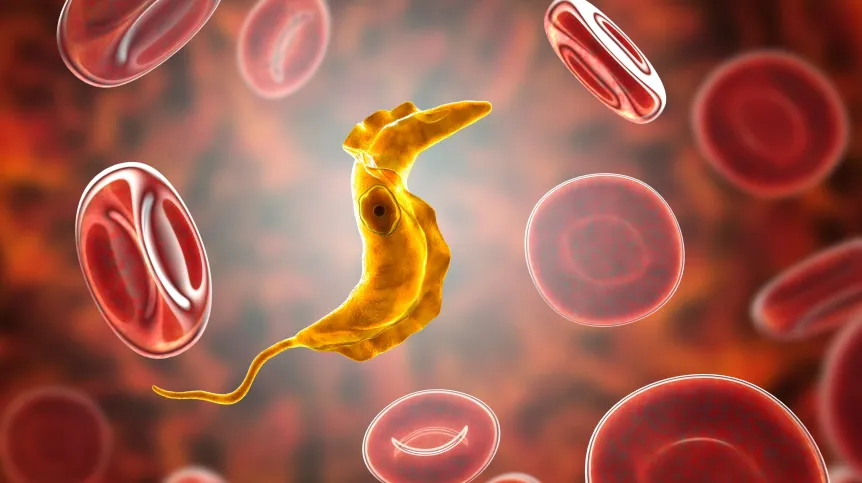
Trypanosoma cruzi is a flagellated single-celled parasite that causes Chagas disease, one of the most serious parasitic illnesses in Latin America. Infection most often occurs through bites of blood-sucking hemipteran insects, although it can also be transmitted through blood transfusions, organ transplantation or from mother to child.
Researchers focused on peroxisomes, small intracellular structures that play a crucial role in the parasite’s metabolism.
“The peroxisomes of these flagellates are unique because they are the only known case in which glycolysis, the basic process of extracting energy from sugars, occurs within them, rather than in the cytoplasm as in most organisms. However, all glycolytic enzymes must be supplied externally. Disruption of this transport leads to the death of the parasite, which makes it a potential target for combating Trypanosoma cruzi,” Professor Grzegorz Dubin from the Małopolska Centre of Biotechnology at Jagiellonian University said.
Peroxisomes do not produce their own proteins, meaning enzymes must be transported into them from the cytoplasm. This process relies on a specialised system of intermediary proteins.
Previous studies showed that the Pex5 receptor recognises enzymes destined for peroxisomes. Located in the cytoplasm, it identifies these enzymes through a short amino acid signal. After binding the enzyme, Pex5 moves toward the peroxisome and interacts with another protein, Pex14, which is anchored in the organelle’s membrane.
Until now, however, scientists had only fragmentary information about the structural details of these interactions.
Researchers from Dubin’s group used cryoelectron microscopy and X-ray crystallography to determine the three-dimensional structure of a complex consisting of the enzyme, the Pex5 receptor and a fragment of the Pex14 protein.
The results showed that Pex5 does not assume a single fixed position relative to the enzyme. Instead, the receptor can move and adopt different orientations while remaining attached to the enzyme.
This flexibility allows the transport system to perform several functions at once. The receptor must hold the enzyme securely so it is not released prematurely while also interacting with proteins in the peroxisome membrane to deliver its cargo.
The researchers also found that the binding of Pex5 to Pex14 does not automatically trigger the release of the enzyme, contrary to some earlier hypotheses. Instead, the interaction appears to stabilise the transport complex at this stage of the process.
Although the study focuses on fundamental molecular mechanisms, the findings may contribute to future efforts to develop treatments against Trypanosoma cruzi.
“We are currently focusing on finding inhibitors that would block the interaction of the receptor with the enzymes it transports. We hope that such compounds will be effective against the parasite and, at the same time, easier to develop than currently known inhibitors,” Dubin added.
PAP - Science in Poland, Katarzyna Czechowicz
kap/ agt/
tr. RL