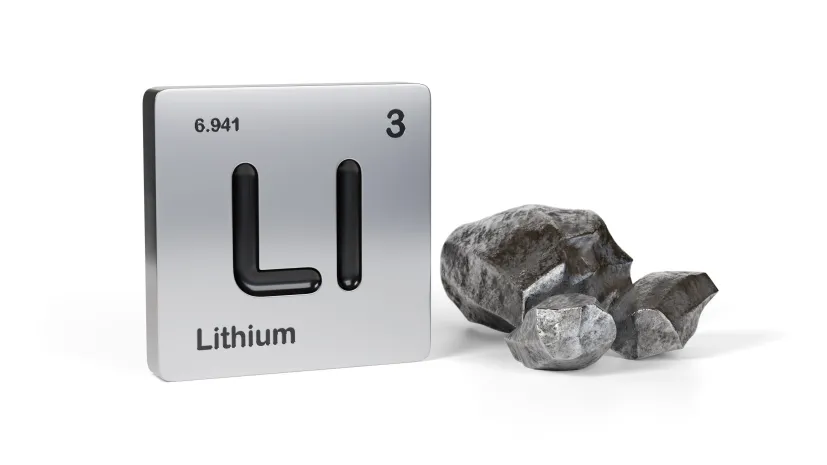
New method developed by Polish chemists allows to recover 95% of lithium from salt waste
Polish researchers have demonstrated a method for recovering nearly all available lithium from solid salt mixtures that mimic waste deposits left after lithium-rich brines are processed, offering a potential way to reduce losses of the critical battery metal.
-
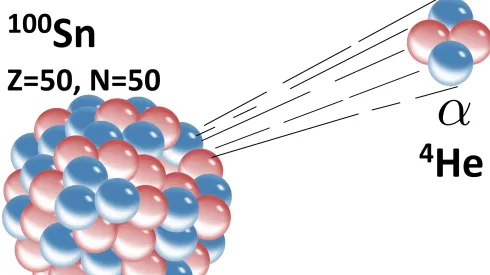
Scientists observe rapid alpha decay from ground state
Scientists have directly observed the alpha decay of tellurium-104 for the first time, providing new evidence about how alpha particles form inside atomic nuclei before they are emitted.
-

Polish scientists develop ‘invisible’ electrode that could boost lasers, sensors and thermal imaging
Polish researchers have developed a new type of electrode that combines high electrical conductivity with unusually high transparency to infrared radiation, a combination that could improve the performance of infrared detectors, lasers, thermal cameras and other optoelectronic devices.
-
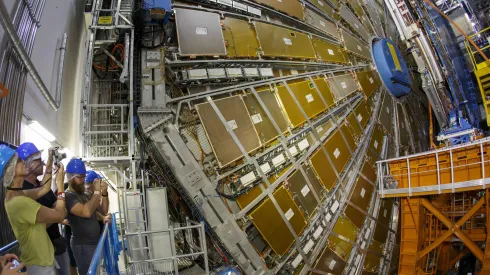
CMS experiment at CERN finds W boson mass consistent with standard model
The CMS experiment at CERN has measured the mass of the W boson with a precision approaching 10 MeV, producing a result consistent with the standard model of particle physics and challenging earlier findings that hinted at possible new physics.
-
Polish-Chinese team prints ‘vortex beam generator’ directly on optical fibre
Researchers from Poland and China have developed a method for printing microscopic structures directly onto the end of optical fibres to generate so-called vortex beams, a technology seen as a potential route toward higher-capacity optical communication systems.
-

Warsaw scientists develop AI-assisted imaging method for semiconductor nanostructures - thanks to black holes
Scientists from the Warsaw University of Technology have developed a computational imaging method that can precisely measure semiconductor nanostructures from a single optical image, potentially speeding up quality control in photonic chip manufacturing and quantum technologies.
-
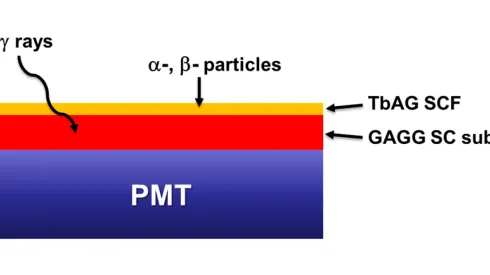
Polish-Ukrainian team develops detector to identify multiple radiation types simultaneously
Scientists from Poland and Ukraine have developed a new type of detector capable of simultaneously identifying different kinds of radiation, a breakthrough that could improve medical treatments and radiation protection systems.
-
AI model predicts atomic motion in molecular simulations, boosting speed nearly 100-fold
An international team of researchers has developed an artificial intelligence model that can predict the motion of atoms in molecular systems directly, dramatically speeding up simulations used in chemistry, physics, and materials science. The model, called MDtrajNet, bypasses the traditional step-by-step calculations of atomic positions, a process that can require millions of steps and substantial computing power.
-
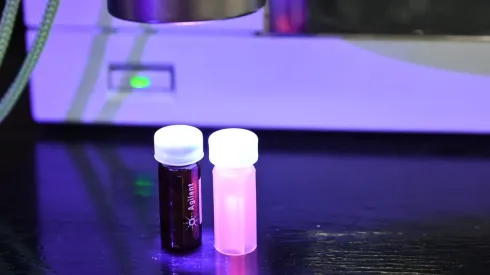
Polish scientists develop quantum dot system to deliver chemotherapy drugs directly to tumours
Scientists from the Warsaw University of Technology are developing a system designed to deliver chemotherapy drugs directly to tumours using nanometric carriers, which could reduce damage to healthy cells and improve treatment effectiveness.
-
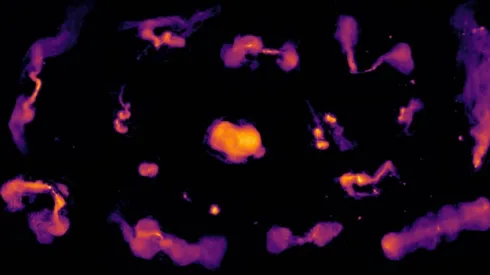
Scientists create largest and most detailed radio map of the Universe
An international team of scientists has produced the largest and most detailed radio map of the Universe to date, revealing 13.7 million active galaxies and pinpointing the locations of supermassive black holes.
Most Popular
-

Joint grave of two women marks first confirmed same-sex medieval burial in Poland
-
Hundreds of monumental tomb structures have been discovered in Africa thanks to the analysis of satellite images
-
Dormant brain cells help repair blood vessels after stroke, study finds
-
European scientists warn of growing pressure on academic freedom
-
Electric pulses and calcium tested as new weapon against pancreatic cancer
Recommended
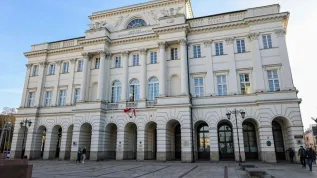
European scientists warn of growing pressure on academic freedom
Instances of restrictions on academic freedom are being observed across several European countries, researchers and representatives of young academies said during a meeting in Warsaw in May, where participants warned that scientific independence is being shaped not only by political decisions but also by funding systems, institutional policies and public pressure.